« Free to choose one’s publication venue »
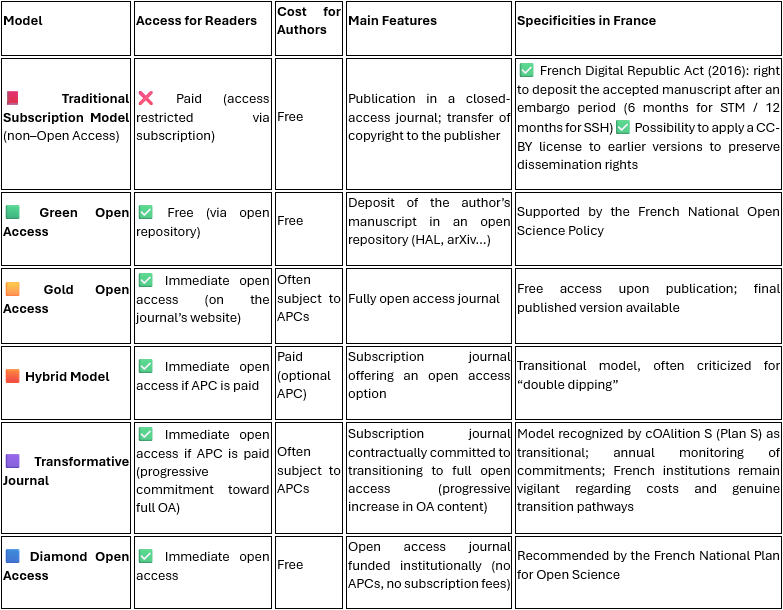
The fundamental principle of scientific publishing remains the academic freedom of authors with respect to the plurality of publishing economic models (Table 1). That being said, freedom to publish should not come at any cost. In this regard, the following recommendations deserve to be recalled, particularly in view of (i) publications resulting from projects funded under the PEPR FORESTT framework, which fall under the ANR and its Open Science policy (https://anr.fr/fr/lanr/engagements/la-science-ouverte/), and (ii) questionable publishing practices.
Table 1 : Different Economic Models of Scientific Publishing
Recommendation No. 1 : “Authors are encouraged to prioritize depositing their publications in an open repository”
Considering the objective set by French research institutions(1) to achieve 100% open access publications by 2030(2), priority should be given to depositing publications in an open repository (such as HAL in France) and/or in appropriate repositories for associated research outputs, such as datasets and code… It should also be recalled that open science practices are associated with increased citation rates(3).
Recommendation No. 2 : “Authors are encouraged to remain vigilant regarding potentially questionable publishing practices”
Although there is no universally accepted definition of what may be termed a “predatory journal,” aggressive solicitation practices, an almost complete absence of peer review or very poor-quality review, and excessive article processing charges (APCs), among other factors, are strong warning signs. Predatory Journals(4) is an active online database listing predatory journals and publishers, regularly updated; it includes, for example, MDPI journals and the Frontiers in series.
By publishing in such journals, you not only contribute to their financial profit, but your articles are also generally less cited than those published in other journals, regardless of their scientific quality. Therefore, choose your publication venue carefully(5) and avoid :
- Predatory publishers that publish large volumes of articles primarily in exchange for APC payments(6) to increase revenue. A good practice is also to decline being included as a co-author in such initiatives.
- Publishers charging excessively high APCs, disproportionate to actual production costs(7)–it is up to you to define reasonable limits.
- Publishers operating under the hybrid model, which leads to double payment: paying to read (through institutional subscriptions) and paying to publish open access (via APCs). Particular vigilance is required regarding journals that are not covered by “Read and Publish” agreements involving your institution. Only in such cases is it advisable to avoid paying APCs, in order to prevent double payment. In particular, when publishing in a hybrid journal covered by the French Couperin agreement(8), APCs are prepaid, and open access publication is fully appropriate, since the agreement covers both subscriptions and APCs.
NB1. Special attention should be paid to journals not included in “Read and Publish” agreements involving our supervising institutions. Only in those cases should APC payment be discouraged to avoid double payment. When publishing in a hybrid journal covered by the French Couperin agreement, APCs are prepaid and open access publication is fully compatible with the agreement.
NB2. In some submission systems, the corresponding author’s affiliation is automatically scanned to determine eligibility for discounts or APC waivers under institutional agreements. However, caution is required: once the negotiated quotas under such agreements are reached, APCs must be paid by the author. For other hybrid journals, publication is not prohibited but should be discouraged.
As a corollary to this recommendation, prioritize journals run by learned societies, whose profits are reinvested in the discipline (e.g., funding conferences, supporting early-career researchers, and maintaining non-profit editorial activities).
That said, not all society journals are automatically virtuous. You should therefore verify their economic model, copyright policy, and compliance with Plan S requirements.
Recommendation No. 3 : “Authors are encouraged to make their publications available under a CC-BY license, irrespective of the economic publishing model selected”
When publishing in a subscription-based journal, implement the Rights Retention Strategy by applying a Creative Commons CC-BY license to all versions prior to the publisher’s final published version. This best practice(9) will allow you to avoid the 6-month embargo period (in biology) or 12-month embargo period (in SSH) on the post-print (author accepted manuscript) deposited in HAL.
NB1. The tool https://openpolicyfinder.jisc.ac.uk/ allows you to check, for each journal, the embargo periods applicable to self-archiving.
NB2. The Rights Retention Strategy is a legal mechanism that enables authors to retain sufficient rights over their scientific articles, thereby allowing their immediate open access dissemination (without embargo on author versions), regardless of the journal’s publishing model. It helps ensure rapid and unrestricted circulation of knowledge within the scientific community and beyond.
NB3. Never sign a “Copyright Transfer Agreement” (CTA); instead, sign a “License to Publish.” If a CTA has already been signed, deposit your article in an open repository by applying the rights granted under the French Digital Republic Act (Loi Lemaire).
NB4. The CC-BY license allows an article to be translated into any language other than the original one, which facilitates its appropriation by diverse linguistic communities.
Recommendation No. 4 : “Authors are encouraged to carefully assess the characteristics of the journal prior to submission”
Using the tool https://journalcheckertool.org/, you can verify, depending on the journal and the type of funding, which publishing route ensures compliance with Coalition S requirements (https://www.coalition-s.org/plan-s-funders-implementation/).
Depending on your field, there are also curated lists of more responsible or community-driven journals. For example, in ecology and evolution, see: https://ecoevorxiv.org/repository/view/9495/.
The PEPR FORESTT Steering Committee, together with the coordinators of the 15 projects, has clearly expressed its ambition to promote open science and the rapid dissemination of knowledge, reduce dependence on the traditional commercial publishing system, and enhance the visibility and recognition of researchers’ and reviewers’ work. This ambition is embodied by the journal PCJ–https://peercommunityin.org/pc-journal/.
Recommendation No. 5 : “Authors are encouraged to ensure full transparency by disclosing any use of AI-assisted tools, particularly generative AI”
Limit the unnecessary use of generative AI to possible linguistic or editorial assistance, and ensure transparency by explicitly stating this in a paragraph such as « Use of Artificial Intelligence (AI) and AI-assisted Tools » at the end of your article :
- The authors declare that no artificial intelligence tools were used in the preparation of this manuscript.
- The authors used an AI-based language model (xxx) to assist with minor editorial improvements and language refinement. No AI tools were used for data generation, analysis, interpretation, or decision-making. The authors critically reviewed, edited, and validated all AI-generated content and assume full responsibility for the final manuscript.
- During the preparation of this manuscript, two AI-assisted tools were used for language improvement exclusively : xxx and yyy. xxx was used to enhance clarity, consistency in language, and refine the academic writing style. yyy was employed to support grammar checking and spelling correction. All outputs from these tools were critically reviewed, edited, and approved by the authors to ensure accuracy, integrity, and originality.
In the case of other justified uses (e.g., coding assistance, writing support, topic exploration), add an appropriate pictogram or a paragraph such as « Use of Artificial Intelligence (AI) and AI-assisted Tools » at the end of your article, like :
- AI-assisted tools were used to enhance graphical presentation and improve figure layout. No AI tools were used for data analysis, interpretation, or generation of results. All figures were validated by the authors.
- During the preparation of this study, the authors used xxx to assist with code development, including syntax suggestions and debugging support. The AI tool did not generate scientific hypotheses, experimental design, or interpret results. All code was reviewed, tested, and validated by the authors, who take full responsibility for its accuracy and the integrity of the results.
Recommendation No. 6 : “Include the following sentence in the acknowledgements”
This acknowledgment sentence must be included in all publications that have benefited from the support of PEPR FORESTT (contractual obligation): This work received government funding managed by the Agence Nationale de la Recherche under the France 2030 program as part of the “Forest Resilience” research program (PEPR FORESTT), reference number “ANR-**-PEFO-****”.
Project references (** year of signature of the grant agreement; **** project code) :
- Project gouvernance : ANR-24-PEFO-0001
- Focal project REGE-ADAPT : ANR-24-PEFO-0006
- Focal project X-RISKS : ANR-24-PEFO-0005
- Focal project MONITOR : ANR-24-PEFO-0003
- Focal project FORESTT-HUB : ANR-24-PEFO-0002
- Focal project NUM-DATA : ANR-24-PEFO-0004
- Project BOSFOR : ANR-25-PEFO-0001
- Project DoForChange : ANR-25-PEFO-0002
- Project FEVER : ANR-25-PEFO-0003
- Project MADE IN France : ANR-25-PEFO-0004
- Project MALADAP-TREE : ANR-25-PEFO-0005
- Project MASSIF : ANR-25-PEFO-0006
- Project MICROFOREST : ANR-25-PEFO-0007
- Project QWERTY : ANR-25-PEFO-0008
- Project TOOLS-FOR-ADAPT : ANR-25-PEFO-0009
- Project WIND-SWEEP : ANR-25-PEFO-0010
Recommendation No. 7: “Make sure your publications are deposited and visible in HAL”
The PEPR FORESTT has a HAL collection. You are required to deposit your publications in HAL and complete the “ANR Project” field with the project code (see recommendation no. 6) so that the publications are automatically uploaded to the program’s HAL collection (see screenshot below).
References